

I once worked with a company in the sports world, an individual action-sports league with a passionate but niche following. The company had recently been acquired by an investment firm with aggressive growth expectations. My job was to help them form the strategy to hit their targets. But as we dug into the numbers, something didn’t add up.
The investment thesis had pegged growth projections to the trajectory of major North American team sports leagues: football, basketball, baseball. On paper, it looked reasonable. Sports are sports. But when we examined the data more closely, we found that individual sports follow a fundamentally different growth pattern than team sports. Different audience behavior. Different participation curves. Different ceilings.
The numbers weren’t even close. There was no reasonable path to the returns the investors had projected. Millions of dollars had been committed based on a category error, a failure to distinguish between two things that looked similar but behaved differently.
It was a simple category mistake. And it was going to be very expensive.
The client was so angry with the research we shared that they cancelled the partnership and tried to explain away the findings. But they couldn’t explain away the logic behind them. I read an article a few years later detailing how the firm had lost the majority of their investment when they didn’t reach anywhere near their growth targets.
This is what rationality does, and what happens when it’s misapplied. Logic can build fortunes or destroy them. It can clarify reality or, when the premises are wrong, construct elaborate castles on sand.
Logic is powerful. It builds bridges (literal and metaphorical), catches contradictions, settles disputes, and creates shared understanding where chaos would otherwise reign.
Without rationality, civilization would collapse. It is rationality that makes possible systems of justice based not on vengeance or whim, but on principles and arguments. It gives us philosophy: thoughtful exploration of existence, ethics, beauty, and purpose. It undergirds science through rigorous investigation and reproducible results. It enables architecture, where structures stand because math and design guide creativity. It powers communication, where language moves beyond grunts and gestures into shared, symbolic meaning.
Every time you balance a budget, craft an argument, write a story, or plan your week, you’re using rationality. It takes our raw experiences and observations and begins turning them into meaning. Through structured thought, we are able to say, “Here’s what I see. Here’s what it feels like. Here’s what it might mean.”
Rationality brings order. It helps prevent us from drowning in emotional tides or superstitious fear. It offers paths forward when instinct alone leaves us stuck. It gives us strategies for living wisely, solving problems, and navigating complexity with clarity.
Consider the experience of grief. Two people lose someone they love. One collapses entirely into emotion, overwhelmed, paralyzed, unable to move forward. The other feels the same tidal wave of grief, but begins to think their way through it. They study what loss is. They compare what they are feeling to what they have read, what others have lived, what their tradition has taught. They examine which of their beliefs about the world still hold up under the weight of it, and which were never that sturdy to begin with. They ask precise questions: If love is real, why does its absence hurt this much? If pain is universal, what frameworks have other cultures, other thinkers, other generations built for carrying it? They reason about the structure of grief itself, not to argue it away, but to understand it well enough to live alongside it.
Both experiences are real. But the second person has applied reason to suffering, and reason has handed back a framework strong enough to carry the weight. That is what rationality does. It takes the scattered pieces of experience, examines them, compares them, and offers structures sturdy enough to bear what feeling alone cannot.
Logic requires premises, and premises are chosen, not proved.
Every logical chain rests on assumptions that logic itself cannot verify. Rationality is a magnificent tool, but it is a poor foundation. It tells you whether your argument is consistent. It cannot tell you whether your starting point is true.
Go back to the sports investment story. The financial models were rigorous. The expected-return calculations were internally consistent. The logic, in its own terms, was clean. But the starting premise (that individual sports grow like team sports) was wrong. And no amount of logical sophistication could rescue a flawed foundation. Tidy logic on top of a bad premise produces tidy nonsense, expensively.
That is the first vulnerability. The second is more uncomfortable.
Logic is at its strongest in the middle of a problem, where the data is good, the variables are visible, and there is enough perspective to compare options. It is at its weakest at the edges. At the beginning of a chain of reasoning, where premises have to be chosen rather than derived. And at the end, where conclusions get extrapolated past what the evidence actually supports, often with more confidence than the argument has earned.
If logic were a universal, automatic instrument, we would not need thousands of years of philosophical debate among thousands of different philosophers. There would be a small set of conclusions everyone trained in clear thinking agreed on, derivable by anyone willing to do the work. Instead we have rival schools, ancient paradoxes that resurface every generation, and ongoing disagreement about questions logic has had centuries to resolve. That is not because the philosophers were sloppy. It is because reason, working alone, cannot ground itself.
This is the deeper paradox at the heart of pure rationalism: reason alone cannot explain why reason works.
Why is the universe structured in a way that is intelligible to the human mind? Why does math “work” to describe reality? Why is logic a reliable tool for navigating existence at all? These are profound mysteries. Science can tell us that mathematics describes the world, but it cannot tell us why the world is mathematically structured to begin with.
Rationality is like a bridge built on pillars we did not construct and cannot fully see.
When rationality tries to step beyond its role, when it becomes the sole lens through which we view reality, it becomes brittle.
Pure rationalism is the belief that reason alone can explain, organize, and ultimately master all of existence. In this view, if something cannot be logically proven or systematically explained, it is irrelevant or imaginary. Emotion is a biochemical distraction. Intuition is unreliable noise. Mystery is a problem to be solved, not a reality to be respected.
At first glance, this sounds noble. It demands clarity in a confusing world. But push it far enough, and three cracks appear.
The first is that rationalism dismisses what it cannot contain. Emotions are reduced to chemical reactions. Beauty is categorized as evolutionary preference. Love is analyzed into neurotransmitter activity. There may be pieces of truth in these descriptions. But the lived meaning of these experiences is lost when rationality insists on reducing everything to parts. We don’t live like creatures who believe love is just chemicals. We don’t grieve like people who think companionship is just evolutionary utility. And deep down, we know it. As Blaise Pascal famously wrote, “The heart has its reasons which reason knows nothing of.”
The second is that rationalism overvalues certainty. It promises that if we just reason carefully enough, all dilemmas will untangle, all mysteries will evaporate. But real life doesn’t work that way. Ethical dilemmas, relational complexities, existential longings: these are not math problems waiting for better formulas. They require humility, patience, and sometimes the courage to act without perfect knowledge.
The third, and perhaps most serious, is that pure rationalism can drift into dehumanization. When logic is prized above all else, people become numbers, means to an end, variables in an equation. Think of Sam Bankman-Fried and the “Effective Altruism” movement. Bankman-Fried pursued extreme utilitarian calculations, arguing that the end goal (giving away billions to do the most good) justified any means, including deception, risk, and manipulation. His downfall wasn’t a failure of logic. It was a failure to account for trust, dignity, and moral complexity, things logic alone cannot quantify.
When rational calculation replaces moral wisdom, the results are not just cold. They are catastrophic.
This is the distinction I think about often: the difference between rationality and wisdom.
Rationality organizes. Wisdom integrates.
Where rationality builds frameworks, wisdom inhabits them. Where rationality draws maps, wisdom knows when to stay on the road and when to blaze a new trail.
You can meet people who are deeply rational but utterly unwise. They can construct brilliant arguments, spot inconsistencies from a mile away, and solve complex problems, yet still make catastrophic choices about how to live, love, or lead. Likewise, you can encounter people who are not “rational” in the narrow, academic sense but who live with profound wisdom. They understand timing, nuance, empathy, and consequence in ways that no formula can predict.
Rationality is a tool. Wisdom is a life.
The world’s greatest acts of courage, creativity, compassion, and transformation have rarely begun with proof. They have begun with a deep sense of ought, a felt conviction that some things are worth risking, even when certainty is impossible. The abolition of slavery, the movements for civil rights, the founding of hospitals and universities, the leaps of exploration into unknown seas and skies. These were not the products of cautious, provable reasoning alone. They had reasons, sure. But so did their opponents. What distinguished them was something beyond logic: wisdom, moral conviction, the willingness to act when the argument wasn’t yet settled.
Reason can light the path, but it can’t tell you where to go. It can clear away some of the fog. It can help you avoid obvious pitfalls. But the destination, the purpose, the “why,” comes from a deeper place.
A coherent life requires rationality. But it also requires heart, will, wonder, and courage. Rationality is not the enemy of those things. At its best, it partners with them. It takes the wild, fierce reality of life and gives it shape, not to tame it, but to make it inhabitable.
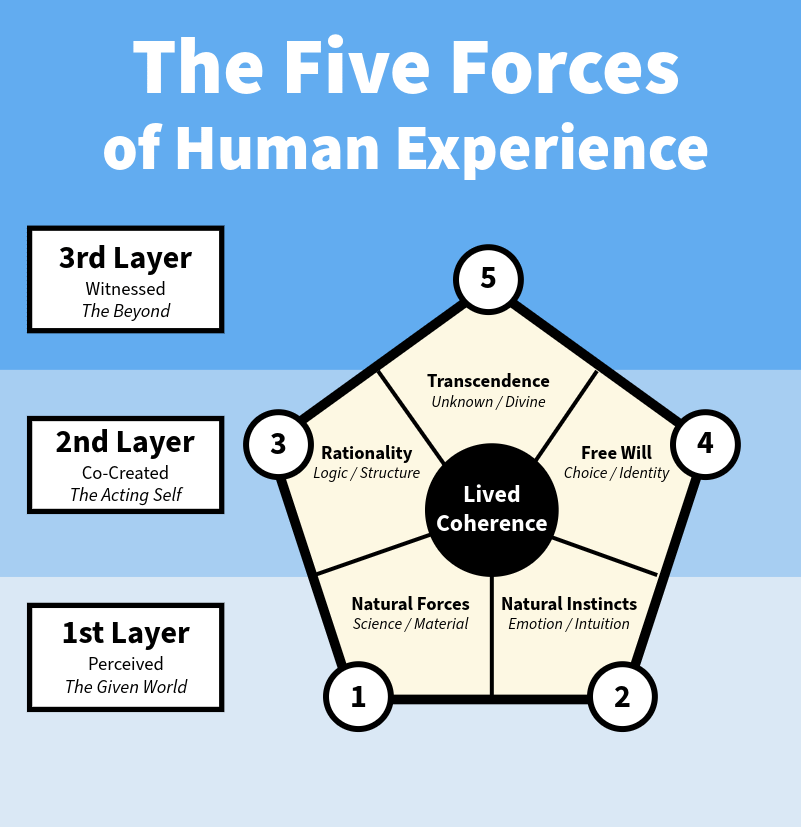
Each of the other forces speaks into rationality’s work. Emotion gives it heart, because rational structures without compassion can become cold and cruel. Science gives it data, because rationality needs real-world anchors to prevent it from becoming untethered speculation. Free will gives it meaning, because rationality can offer options but only choice turns those options into direction. And transcendence gives it humility, because rationality hits its limits when it encounters mystery, awe, and the unknown.
The reasoning machine is one of the greatest tools we possess. But a tool is not a master. And the goal isn’t simply to think correctly. It’s to live wisely.
That is a higher, richer, and more human calling.