

Forget religion for a minute. There are moments of my life that I cannot explain.
Sitting on a foggy mountaintop at 10,000 feet in New Mexico, the whole world became still. My body felt weightless. My mind descended into a gentle and unfamiliar calm. I hadn’t sought it. I hadn’t earned it. I hadn’t “believed” in anything to achieve it. And yet there it was: unmistakable, visceral, holy in a way that had nothing to do with doctrine.
Then there was the afternoon my now-wife and I first texted to meet. On a whim, a friend offered to read our tarot cards. This was not a normal activity for either of us but, sure, why not? In the place where the cards supposedly reveal what’s coming next, we each drew the same image, signifying a similar destination on the horizon. You could explain it away as coincidence, but something about it felt charged, as if a higher power had briefly pulled back the curtain and whispered: pay attention.
Or the day I watched a friend’s dog while he was in surgery for kidney cancer. The dog, normally calm, suddenly raised her head and let out a long, mournful howl. It was so striking that I glanced at the clock. Later that evening, when my friend’s wife called to say the operation had gone well, I asked what time it had begun. It was the exact minute of the howl.
None of these stories require belief in God or appeal to the supernatural. Each could be dismissed as coincidence, confirmation bias, or the mind’s talent for pattern-making. But that explanation doesn’t quite satisfy. Because even if the events are statistically ordinary, their texture isn’t. They feel alive with significance. They carry weight.
Why? Why do we feel meaning where none is “provable”? Why do such moments stir something deeper than reason or instinct, something that feels like recognition?
There’s a category of experience that exceeds measurement, logic, and agency.
Standing at the edge of the Grand Canyon. Holding a newborn. The moment after the music stops. The sudden hush in your chest when the horizon stretches further than your mind can follow. In those moments, you feel small, but not meaningless. Somehow, the vastness makes you feel more real, not less.
We feel it when we encounter beauty so vivid it bypasses reason. The touch of a loved one’s hand that stops you mid-sentence. A moment of silence that feels somehow full.
These are not glitches in the matrix. They are the moments when something in us recognizes something beyond us. We don’t analyze it right away. We just know, in a way that goes deeper than proof.
Every culture in human history has reached for something beyond the material. Some have called it God. Others, Tao, Brahman, the Source, the Unknown, the Universe. The names change. The underlying intuition doesn’t. Something is beyond the sum of what we can measure, feel, think, or choose. Or at least human beings have never stopped sensing that there is.
You can call it the divine, the numinous, or simply the unknown. Denying it doesn’t make it go away. The question is whether you account for it honestly.
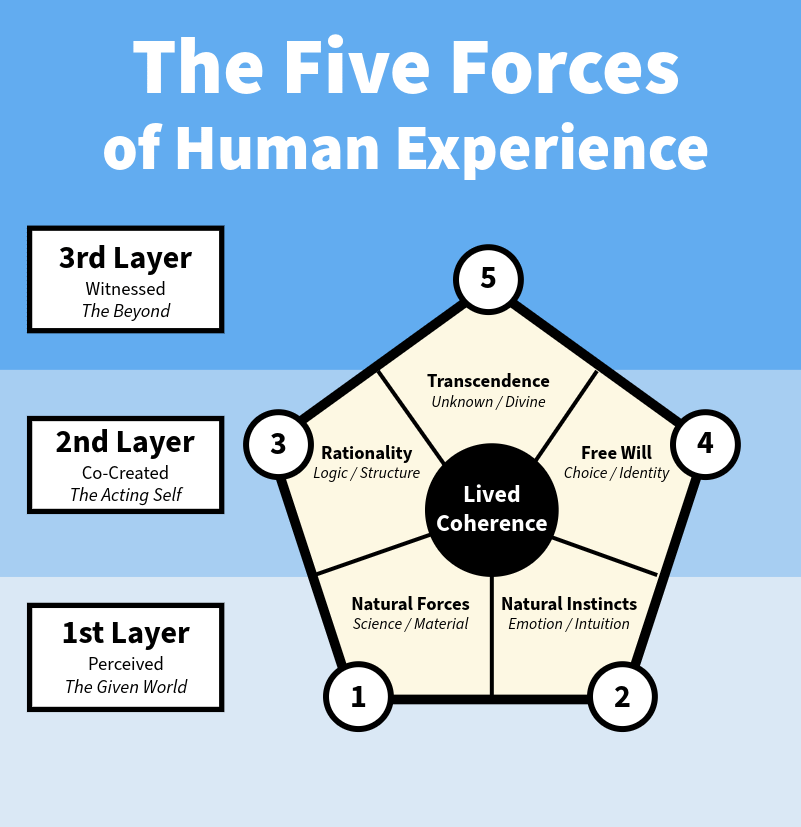
By now, in this series of essays, we’ve walked through four forces that shape human experience: science, emotion, rationality, and free will. Each is real. Each is powerful. And each plays an essential role in helping us navigate reality.
But none of them, on their own or even together, can fully explain why we are here at all. They describe the terrain, but they can’t tell us why the terrain exists. They help us move through life, but they can’t tell us where the story begins or where it’s meant to go.
Science gives us the structure of the universe. It shows us the rules of the game - or many of them at least. But science can’t tell us why there is a universe to begin with. It can describe how energy behaves, but it can’t explain why there is energy at all. It’s like having a partial manual for operating a machine, with no idea who built it or what it’s meant to be used for.
Emotion breathes meaning into our experience. It lets us feel love, grief, awe, and rage. But emotion is reactive. It surges in response to what is, not in creation of what ought to be.
Rationality offers order and clarity. Through logic, we build systems, test ideas, and uncover hidden patterns. Yet logic struggles when confronted with phenomena that are real but not reducible: love, wonder, sacrifice. It struggles with beginnings and uncertainty.
Free will affirms that we are more than machines. It reveals that we have agency, the ability to choose, to change, to create. But free will by itself doesn’t tell us where we should go. It gives us the capacity for movement, but no map for meaning. A steering wheel, not a North Star.
Each of these forces is necessary. But none is sufficient.
Without something deeper, without a binding presence that gives coherence to these forces, we are left adrift. Science tells us how the stars move, but not why they shine. Emotion tells us what feels right, but not what is right. Rationality organizes ideas, but can’t crown them with purpose. Free will grants us choice, but not destination.
If Transcendence is such a natural part of human experience, if every culture has named it, if we feel it in our bones, why do so many of us hesitate to embrace it?
The resistance isn’t irrational. In fact, it often comes from deeply rational, deeply human places.
There’s the fear of control or judgment. If Transcendence is personal, if it has intention or will, then that means we are not alone. And that’s not always comforting. For some, a personal God conjures images of shame, condemnation, or a loss of freedom.
There’s intellectual pride and cultural conditioning. In many educated circles, skepticism is seen as intelligence. Mystery is treated like a primitive phase we should have outgrown. We’ve been subtly taught that belief in the unknown is naive, or worse, dangerous.
There’s the deep human desire for certainty and control. Transcendence resists both. It cannot be pinned down, proven, or predicted. For those of us used to solving problems or optimizing life, that can be profoundly unsettling.
And then, there are the wounds. Some people carry very real pain from religion or spiritual authority. They’ve been shamed, excluded, manipulated, or abused in the name of God. When you’ve been hurt by those who claim to speak for the divine, the safest move is to shut the door completely.
These are not minor obstacles. They are legitimate reasons for caution. But caution is not the same as closure.
At the heart of our resistance may be a deeper myth: that mystery is weakness. That not knowing is a failure. That doubt or openness signals immaturity. But the opposite is true. The refusal to acknowledge mystery is often what keeps us stuck. Mystery, when faced honestly, has always been the birthplace of wonder, growth, and transformation.
Even people who identify as purely secular often make room for Transcendence. They just give it other names.
They talk about “the universe having a plan.” They say things “happen for a reason.” They speak of “purpose,” even if they can’t define who or what is assigning it. They trust in progress, as if the arc of history naturally bends toward justice, which is itself an act of faith. They talk about being “called” to a certain vocation or “meant” to meet a particular person.
These aren’t strictly scientific ideas. They’re signals of something deeper. A quiet agreement that life is more than randomness and physics.
The irony is that many people who say they don’t believe in anything transcendent still live as if they do. They hold weddings with vows that invoke forever. They grieve as though love is eternal. They marvel at stars, kiss their children goodnight, and hold onto meaning in ways no spreadsheet can explain.
Because Transcendence isn’t primarily a doctrine. It’s an encounter. It’s not about arriving at certainty. It’s about recognizing that certainty isn’t the only doorway to truth.
Imagine the four forces like planets spinning in space: Science, Emotion, Rationality, Free Will. Each powerful, each distinct. But without a gravitational center, their paths would be chaotic. They would drift away, collide, or simply freeze in stillness.
Transcendence is the gravitational center. It is the unseen mass that holds the system together. It gives the planets their orbits, their structure, their meaning.
Without Transcendence, we don’t just lose “religion” or “faith.” We lose coherence. We lose the ability to live fully as humans, because we sever the connection between the parts of ourselves that need to speak to each other.
If the human experience were a book, Transcendence would not be a footnote. It would be the binding. It’s what holds the whole story together, even if we can’t always see it directly on the page. Without it, the forces we’ve explored (science, emotion, rationality, free will) start to drift apart. They become tools without a task, songs without a singer, journeys without a destination.
Acknowledging Transcendence doesn’t end the search for understanding. It deepens it. It’s choosing to ask better questions. Not just how things work, but why they exist in the first place. Not just what we feel, but what our feelings are pointing to. Not just what choices we make, but what those choices mean in the grand scheme of things.
The goal isn’t to drag anyone back into blind faith. It’s not to reintroduce dogma or to pretend we know exactly what lies beyond the veil. The goal is to reopen the door. To consider, with fresh eyes and honest hearts, the possibility that something more is not only real, but necessary.
You don’t have to surrender your intellect to honor the unknown. You don’t have to abandon your autonomy to explore the divine. What’s required is something more difficult, and more beautiful: humility. Curiosity. And the courage to look beyond the edges of what we can prove.
Those moments when you feel pierced by beauty, arrested by mystery, or grounded by a sense of connection that defies logic: those are not accidents. They are clues.
Transcendence isn’t something you have to summon. It’s already happening, already here. The question is whether we’ll notice it, and whether we’ll let ourselves follow where it leads.
Because at the edges of life, we all touch something deeper. We all intuit that there is a beyond. And that intuition isn’t weakness. It’s one of our clearest acts of integrity.