

When my daughter was born, her lungs weren’t working properly. She’d inhaled fluid during delivery, and within minutes of entering the world she was in the neonatal ICU. I sat behind glass watching machines monitor her breathing, tubes delivering oxygen, screens tracking numbers I didn’t fully understand. I was terrified. And I was profoundly grateful for modern science.
I shudder to think what might have happened a few decades earlier. But thanks to advances in neonatal medicine, we brought her home days later. She’s thriving today.
Ricky Gervais has a bit about people who pray for loved ones with cancer. To paraphrase: “I’d really rather just have the medicine, thank you.” I wouldn’t put it quite that way, but I understand the emphasis. When your newborn’s lungs aren’t working, you want the science that works. No mysticism, no metaphor. Just the astonishing fact that by understanding the laws of nature, we can bend them toward healing.
Science is extraordinary. Full stop. It deserves to be celebrated before it is critiqued.
Through science, we understand how diseases spread and how they can be stopped. We know that if we apply enough thrust, an object will leave the earth’s atmosphere. We know the chemical composition of water, the structure of DNA, the speed of light. These are not random guesses. They are hard-won insights, earned through centuries of patient inquiry.
Consider the launch of a spacecraft. Thousands of forces must be precisely measured and balanced: gravity, inertia, air resistance, propulsion. Every calculation, every material, every trajectory has to align with natural laws that don’t bend to human desire. And yet we’ve landed rovers on Mars. We’ve sent probes beyond the edges of our solar system.
Or look back to the Scientific Revolution. Before it, large parts of human knowledge were rooted in superstition, tradition, and the unquestioned authority of kings and priests. The revolution wasn’t just about discovering new facts. It was about changing the very method by which we seek truth. Instead of asking, “What have we always believed?” the scientific mind asks, “What can we test? What can we observe? What matches reality, even if it’s inconvenient?”
This is humility at its best. Science acknowledges that our current understanding is provisional. It remains open to being wrong. It demands evidence before acceptance. It insists that truth should be tested, not simply declared. Newton’s laws gave way to Einstein’s relativity. Classical physics made room for quantum mechanics. Each generation of knowledge isn’t a betrayal of the last. It’s a refinement. A deepening.
Science doesn’t claim to know everything. It claims to know some things, and to keep learning more. That posture is rare in human history.
Science is a powerful, indispensable tool. It has revealed worlds within worlds, from the spiraling beauty of DNA to the vast expanse of distant galaxies. It gives us answers to some of the most pressing “how” questions humanity has ever asked.
But science has boundaries. It was never designed to answer every kind of question. That’s not a flaw. It’s a feature.
Science can tell us how, but it cannot tell us why.
It can describe the chemical composition of a sunset, but not why it moves us to tears. It can map the neurological pathways involved in love, but not why we sacrifice for those we love, or why love feels sacred. It can chart evolutionary strategies for survival, but not why we feel moral outrage at injustice that doesn’t affect us personally. It can explain the brain’s electrical activity when we feel awe, but not what awe means.
And science cannot answer the biggest “why” questions of all: Why does anything exist? Why is there something rather than nothing?
Science can investigate conditions within the universe, but it cannot explain why the universe itself exists. It can study space-time, but not what (or who) set it in motion. It can describe processes, but it cannot create purpose.
This boundary doesn’t diminish science. It simply places it within a broader framework.
The mistake, I think, comes when we confuse the tool with the whole toolkit.
There’s a growing belief system that tries to stretch science far beyond its natural limits. It’s called scientism: the philosophical claim that science is not just a way to truth but the only valid way. If something can’t be empirically verified, the thinking goes, it must be meaningless or imaginary.
At first glance, this sounds rigorous. Why trust anything you can’t test?
But look closer, and cracks appear.
First, scientism itself is not a scientific claim. It’s a philosophical one. You cannot test, measure, or prove in a lab the idea that “only science can reveal truth.” That’s a worldview assumption. A starting belief. In other words, scientism requires faith.
Second, scientism depends heavily on what we might call the “science will get there eventually” fallacy. It assumes that all mysteries are temporary. That every “why” will someday become a “how” as our methods improve. That love, morality, consciousness, and even existence itself will eventually be reduced to equations, brain scans, or physical processes.
But that’s not a scientific conclusion. It’s a hope. A belief. And so far, many of the biggest questions haven’t moved closer to empirical resolution. Despite massive advances in neuroscience, consciousness (the sense of self, of subjective experience) remains a profound mystery. Despite evolutionary theory explaining social cooperation, moral obligation resists purely biological explanation. Despite mapping the Big Bang and quantum fields, the question of why there is something rather than nothing remains unanswered.
The ever-expanding frontier of measurability is real, and it’s magnificent. But the mistake is assuming that what science hasn’t measured yet simply doesn’t exist.
I want to push on this point, because I think it matters deeply for how we live.
When Natural Forces are treated as the only reality, when what can be measured becomes the sole standard for what is considered “real,” we fall into materialism. And materialism, taken to its logical conclusion, makes the world unlivable.
If love is just chemicals, why sacrifice for it? If morality is just a social habit, why fight for justice when it costs you? If art is just neural patterning, why does a single painting undo you in ways you can’t explain?
Imagine trying to raise a child under strict materialism. Every time your child runs into your arms, cries at a scraped knee, or tells you they love you, you tell them: “Don’t be fooled, little one. This is just a series of biochemical impulses shaped by evolutionary pressures to ensure gene propagation.”
Could you love that child with tenderness while treating that explanation as the whole truth? I don’t think so.
Because no one actually lives as a strict materialist. We can write books about neurons. We can argue in debates about evolutionary imperatives. But when we sit at the hospital bed of someone we love, or when we stand in awe under a night sky, we betray our deeper knowledge: there is more to life than matter.
Love, meaning, purpose, beauty. These are real experiences that resist the laboratory. The fact that we can’t weigh them on a scale doesn’t make them less real. It makes the scale insufficient.
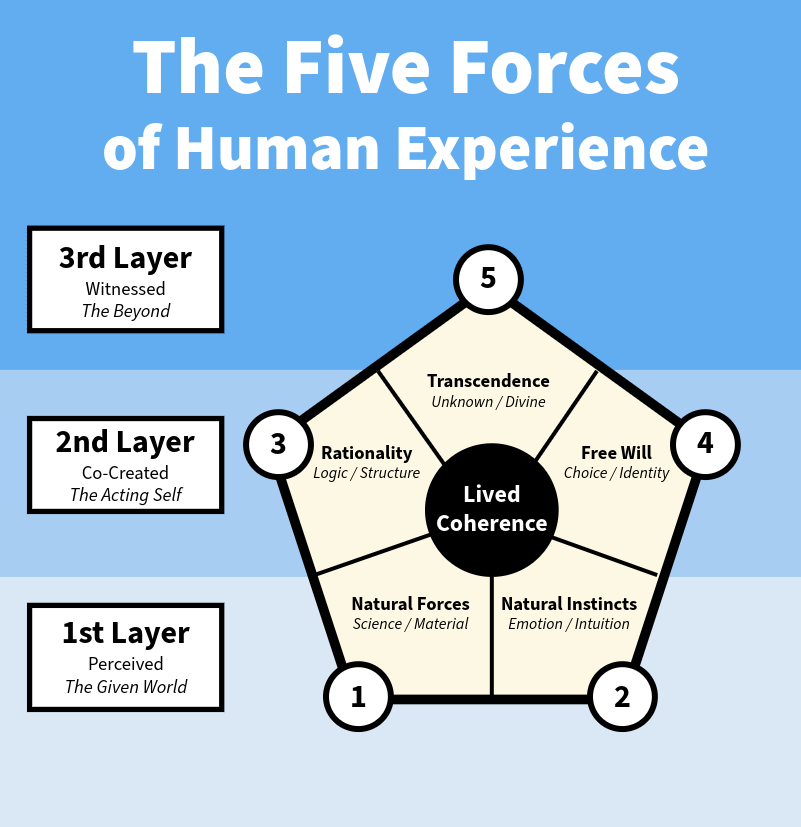
Science is not a faith. It’s a force. It’s not a worldview in itself. It’s a way of investigating reality, one of the tools we use to understand and experience the world, alongside reason, emotion, agency, and wonder. When we treat it as the whole story, we flatten life. When we dismiss it, we cut ourselves off from one of the greatest sources of knowledge and awe we possess.
A worldview that ignores Natural Forces is naive. A worldview that worships them is incomplete. The path forward is not domination or denial. It’s integration.
Science is at its most powerful when it stands in partnership, not in isolation. It partners with rationality to shape clear theories. It partners with emotion to drive the compassionate application of discoveries. It partners with free will as we decide how to use the knowledge we gain. It even partners with wonder, because scientific exploration is ultimately fueled by curiosity and reverence for a universe bigger than ourselves.
The physical world is real. It is ordered. And it invites us to explore, not as detached observers, but as participants in something vast, intricate, and astonishing. The measurable world is the ground floor of existence. What we build on top of it is the story of everything else.
And that story requires more than measurements to tell.