

There is a reason your worldview feels incomplete.
It is not because you are lazy, or uneducated, or spiritually stunted. It is because the worldview you are living by, the one you probably absorbed rather than chose, is almost certainly built on an incomplete picture of reality. It emphasizes some dimensions of human experience while quietly suppressing others. And the parts it suppresses are the parts where the cracks eventually show.
I spent years feeling this without being able to name it. I could construct an argument for almost anything but couldn’t explain why I was moved by a piece of music. I trusted data but couldn’t account for the fact that data alone had never once helped me make a decision about love. I believed in reason, but my most important convictions, that people have dignity, that courage matters, that some things are simply wrong, could not be derived from any equation.
The problem was not that I was irrational. The problem was that I was trying to run my entire life through one or two channels of experience, while the full bandwidth of being human requires at least five.
The Framework
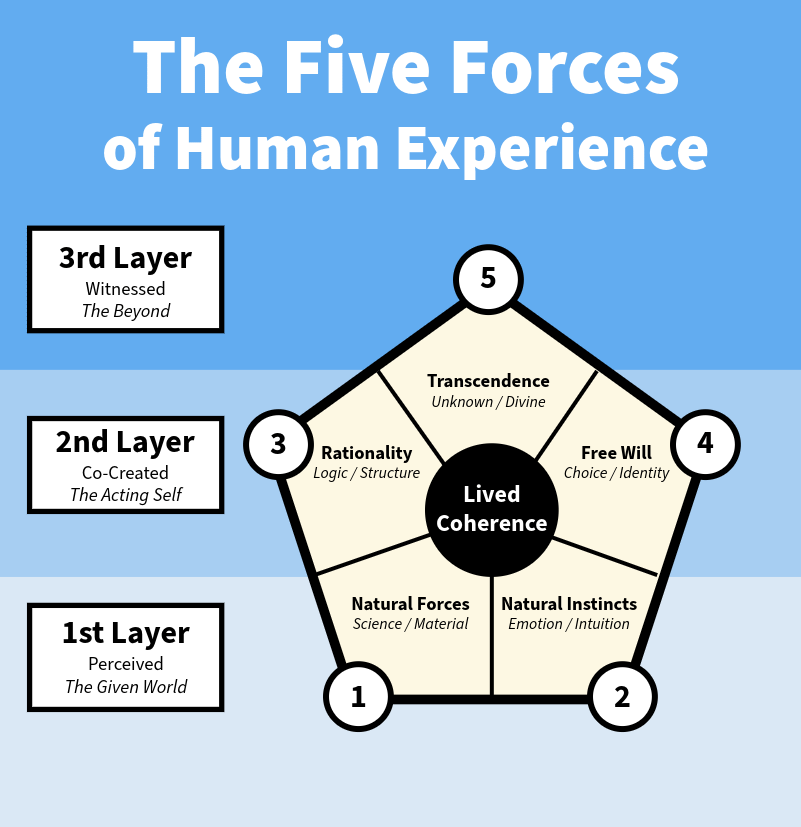
What I am about to describe is not a theory. It is a map of what you already know. Five fundamental ways that human beings experience and interpret reality. You have felt all five. You live in them every day. But chances are, you have never named them together or thought about how they interact.
I call them the Five Forces. They are: Natural Forces, Natural Instincts, Rationality, Free Will, and Transcendence.
These are not abstract philosophical categories. They are the lenses you are already using, right now, to make sense of your life. The question is whether you are using all of them, or whether the worldview you inherited has quietly elevated one or two while letting the rest atrophy.
Force 1: Natural Forces
Start with the physical world. Gravity, chemistry, biology, cause and effect. The measurable, testable, repeatable realm of matter and energy. This is the territory of science, and science has earned every bit of the trust we place in it. Modern medicine, space travel, smartphones, clean water: all of these are gifts of our deepening understanding of natural forces.
Natural forces give us structure. They are why the bridge holds, why the medicine works, why the seasons return. They are the foundation of predictability, and predictability is what makes civilization possible.
But here is what natural forces cannot do. They cannot tell you why something matters. You can describe the physics of a sunset in exquisite detail, the scattering of photons through atmospheric particles at specific wavelengths, and still not have said a single thing about why it takes your breath away. You can map the neural chemistry of a mother holding her newborn and still be no closer to explaining why she would walk through fire for that child.
Science tells us how. It does not tell us why. And the “why” is where most of us actually live.
The person who trusts science is not wrong. They are standing on solid ground. The mistake comes only when science is treated not as a powerful tool but as a total worldview, when it becomes the belief that anything worth knowing must be measurable. That position has a name: scientism. And it is a belief system, complete with unprovable assumptions about the nature of reality. It assumes the universe is orderly, that human minds can grasp that order, and that what cannot be measured does not ultimately count. None of these assumptions can be verified by science itself. They are prerequisites to doing science at all.
Natural forces are real, foundational, and essential. They are also not the whole story.
Force 2: Natural Instincts
Now turn inward. Emotions. Desires. Gut feelings. The pull of attraction, the ache of grief, the flash of anger, the warmth of belonging. This is the realm of natural instincts, and it is far more powerful than most of us want to admit.
Long before you can reason about a situation, your instincts have already responded. You sense danger before you can articulate it. You feel drawn to certain people and repelled by others without understanding why. You walk into a room and know something is off before a single word has been spoken. These responses are not rational in the classical sense, but they are not irrational either. They are pre-rational. They are your oldest and fastest way of reading the world.
Instincts are what make us human in the most immediate sense. Empathy lives here. Creativity lives here. The capacity to be moved by beauty, by injustice, by the sound of someone’s voice breaking in grief. These experiences are not decorative. They are informational. They tell us what matters before our conscious mind has had a chance to weigh in.
The culture tends to be suspicious of instinct, especially in professional and intellectual settings. Feelings are treated as noise. Emotion is cast as the enemy of clear thinking. But consider what life would look like without it. No art. No music. No loyalty. No sacrifice. No falling in love. A world stripped of instinct would be a world of competent machines, optimized and empty.
Where instinct goes wrong is when it operates without any counterbalance. Emotion untethered from reason becomes volatility. Desire without reflection becomes compulsion. Gut feelings, unexamined, can harden into prejudice. The problem is not that instincts are unreliable; it is that they are incomplete. They need the other forces to stay honest.
But dismissing them is its own kind of dishonesty. A worldview that has no room for what you feel is a worldview that has no room for you.
Force 3: Rationality
This is the organizing force. Language, logic, mathematics, abstraction, analysis. Rationality is how we take the raw material of experience and make it coherent. It is how we build bridges, write constitutions, diagnose diseases, and tell stories that make sense. It gives us comparison, consequence, and clarity.
Rationality is elegant. When it works, it feels like the lights coming on. Suddenly the pattern is visible. The argument holds. The numbers add up. There is deep satisfaction in this kind of knowing, and it is one of the great gifts of being human.
But rationality has a boundary that it cannot cross on its own. It can tell you what is logically consistent. It cannot tell you what should be. It can model outcomes. It cannot assign value to those outcomes. It can help you build anything, but it cannot tell you what is worth building.
This is not a flaw in rationality. It is its design. Rationality is a processing engine, not a compass. It needs input from elsewhere, from instinct, from observation, from moral conviction, from something beyond itself, to point in a direction worth going.
The person who lives by reason is doing something admirable. They are seeking clarity in a noisy world. The danger comes when rationality is asked to carry more weight than it was built for. When it is treated as the sole source of truth, it becomes brittle. It dismisses what it cannot categorize. It flattens beauty into formula and reduces love to utility. And when it encounters something it truly cannot explain, consciousness, moral obligation, the sheer fact that anything exists at all, it either ignores the question or pretends the question does not matter.
Rationality connects the dots. But it does not draw the picture.
Force 4: Free Will
This is the force of agency. The capacity to choose. To say yes or no. To resist your instincts, revise your reasoning, defy your circumstances, and do something that no algorithm could have predicted.
Free will is what makes you a person rather than a process. It is the basis of responsibility, morality, and love. If you are not free to choose, then your kindness is just programming, your courage is just chemistry, and your love is just a reflex. None of it means anything.
But if free will is real, and I believe it is, then everything changes. Your choices matter. Your life is not determined. You are not merely a product of your genes, your upbringing, your environment, or your brain chemistry. You are an agent, an author, capable of genuine participation in the story of your own life and the lives of others.
Free will is where things get personal. It is what allows growth: the decision to become more than your past, more than your pain, more than your default settings. It is what makes forgiveness possible, because forgiveness requires choosing something that neither instinct nor logic demands. It is what makes sacrifice meaningful, because sacrifice means choosing a cost that a purely rational actor would avoid.
The risk of free will, elevated without balance, is egoism. If my freedom is the only force I take seriously, then I become the center of my own universe. My truth, my choices, my feelings become sovereign. And when everyone’s freedom is sovereign, community fractures. Relationship becomes negotiation. Disagreement becomes threat.
Free will is essential. But it needs grounding. It needs something to be free for, not just free from.
Force 5: Transcendence
And then there is the one most often ignored, dismissed, or explained away. The sense that there is something more. The experience of awe in the presence of a night sky. The hush that falls over you in an ancient cathedral or at the edge of a canyon. The moment when beauty is so acute it almost hurts, when grief is so deep it opens a door you didn’t know was there.
Transcendence is the name for the irreducible remainder of human experience. The part that does not fit into data sets, emotional categories, logical frameworks, or personal narratives. It is the question behind the questions. The gravity you cannot chart but still feel.
Every culture in human history has testified to this force. Every civilization has built structures to house it: temples, cathedrals, mosques, stone circles, concert halls. It shows up in the mystic’s prayer, the artist’s studio, the scientist’s confession that the deeper they look, the more astonishing it becomes. It is not confined to religion, though religion is one of its most persistent expressions.
Some worldviews try to reduce transcendence to a byproduct of evolution: pattern recognition gone haywire, the brain searching for agency where there is none. That explanation may account for some religious impulses. But it cannot account for all of them. It cannot explain why the experience of transcendence shows up with such stubborn consistency across every era, culture, and personality type. It cannot explain why the smartest people in history, people who could have dismissed it, instead spent their lives pursuing it.
The risk of transcendence, unbalanced, is superstition or dogma: the refusal to test spiritual claims against reason and evidence. But the risk of ignoring it altogether is something worse. It is the quiet flattening of human experience into a world with no ceiling. A world where everything can be explained, everything can be optimized, everything can be managed, and nothing is sacred.
Transcendence is the space where reason reaches its edge and something else begins.
The Core Insight: Every Worldview Is a Weighting
Every belief system, whether it announces itself as one or not, is built on a particular weighting of these five forces. It elevates some and suppresses others. And most of us have never examined which forces we have elevated or which we have let go quiet.
Scientific materialism elevates Natural Forces and Rationality. It gives you precision and predictability. But it often dismisses instinct, agency, and transcendence. The result is a worldview that can build a rocket but cannot tell you whether the trip was worth taking.
Consumerism and success culture elevate Natural Instincts and Free Will: desire and personal agency. They give you ambition and momentum. But they flatten rationality into optimization and have no room for mystery. The result is a worldview that keeps you running but never tells you when to stop.
Egoism and modern self-help culture elevate Free Will and Natural Instincts: personal truth and internal emotion. They give you autonomy and self-awareness. But they struggle to explain anything beyond the self. The result is a worldview that honors the individual but fragments the community.
Religious fundamentalism can fixate on Transcendence while suppressing scientific inquiry, rational questioning, or emotional honesty. The result is a worldview that insists on answers it has not earned.
Nihilism acknowledges the limits of all five forces and then abandons the project entirely. It is the only worldview that is honest about the problem and completely useless for solving it.
Each of these positions captures something real. The scientist is not wrong for trusting data. The mystic is not wrong for trusting transcendence. The person who prioritizes personal freedom is not wrong for valuing agency. The one who follows their gut is not wrong for trusting instinct.
The error is not in what they trust. It is in what they suppress. And the suppression is usually invisible to the person doing it.
This is the fragmentation people feel but cannot name. The sense that something is missing, that their worldview works in some situations but not others, that they are confident in one area of life and completely lost in another. It is the result of running a five-channel human experience through a one- or two-channel worldview.
What Integration Looks Like
A coherent worldview does not pick a favorite force and ride it to the end. It integrates all five. It honors science without worshiping it. It trusts emotion without being ruled by it. It uses reason without assuming it is everything. It respects choice as sacred. And it leaves room for the unknown.
This does not mean treating all five forces as equal in every situation. Sometimes the data should overrule your gut. Sometimes your gut is telling you something the data cannot see. Sometimes reason leads. Sometimes mystery does. The art of a coherent life is knowing which force to follow in which moment, and that judgment only develops when you have practiced listening to all of them.
Integration also does not mean certainty. A worldview built on all five forces will still have tensions. Natural Forces and Transcendence press against each other. Rationality and Instinct do not always agree. Free Will creates friction with every other force. These tensions are not a bug. They are the texture of a worldview that is honest about the full complexity of being human.
What Wisdom Might Be
I want to end with an observation that has become, for me, something close to a conviction.
When a person glimpses truth through all five forces at once, when their understanding of the physical world, their emotional depth, their rational clarity, their sense of agency, and their experience of something beyond themselves all converge on the same insight, there is a word for what happens.
It is called wisdom.
Wisdom is not intelligence. Intelligent people can be unwise. It is not expertise. Experts can be narrow. It is not spiritual depth alone. Deep spirituality without grounding in reason or reality can become delusion.
Wisdom is the integration of all five channels. It is what happens when you stop suppressing parts of your experience to protect a tidy worldview and instead allow the full bandwidth of your humanity to inform how you see, choose, and live.
The wisest people I have known, and there have not been many, shared a common quality. They were at home in all five forces. They could follow an argument and still be moved by beauty. They could trust their instincts and still submit them to scrutiny. They made choices with conviction but held those choices with open hands. They lived in the material world without being consumed by it and sensed something beyond it without losing their grip on reality.
They were not certain about everything. But they were coherent. And their coherence was not brittle. It could hold contradiction, bear suffering, and still make room for joy.
That is what I am after. Not a system that answers every question, but a framework that can hold every question. Not certainty, but the kind of integration that makes a life worth living.
The Five Forces are the starting point. They are the map of the terrain. What you do with the map is up to you. But I would suggest this: before you decide what you believe, take an honest inventory of which forces you have been listening to and which you have been ignoring. The places where your worldview feels thin or fragile are almost always the places where a force has been suppressed.
Name all five. Honor all five. And see if the picture that emerges is more coherent than the fragments you have been living with.
Because you were not made to live in fragments. You were made for something whole.