

It happened at a wedding. One of those nights when conversations run long, laughter is easy, and the whole room seems briefly suspended outside ordinary life. I was introduced to a woman from another country, someone I assumed was attending with the man beside her. We exchanged only a few minutes of small talk, nothing that would have impressed a rational observer. And yet something in me, quiet but unmistakable, leaned toward her. Not desire. Not calculation. Just a hunch. A sense. An intuition that she was someone I was meant to know.
I resisted the pull at first. My rational mind was grasping for control. But the next day, acting on nothing more than that feeling, I invited her and what I thought was her date to join me for a walk. She declined. He accepted. Only near the end of the walk did he casually mention that they weren’t a couple at all, just friends traveling together.
Two weeks later I was on a plane flying across an ocean to visit her in her home country. Today she is my wife and the mother of our children.
You could try to explain that story scientifically. Some evolutionary impulse toward bonding. Some unconscious symmetry of features or compatible pheromones. But that doesn’t tell the truth of it. Why her? Why that moment? Why a feeling so strong it pulled me thousands of miles from home?
Sometimes emotion isn’t a distortion of reality. Sometimes it is the first glimpse of it.
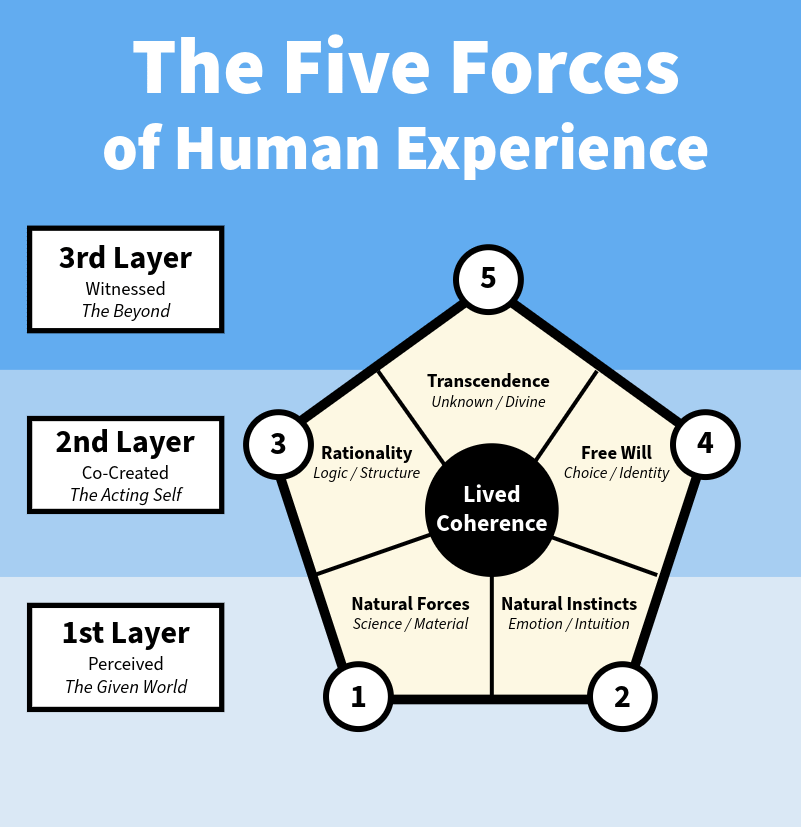
If the natural forces that govern physics and biology are the external laws that shape the world, then Natural Instincts are the internal forces that shape our inner lives. They include fear, joy, love, longing, anger, empathy, grief, and beauty. They are the heartbeat of our lived reality, the primal currents that move us before we can even name what we feel.
Emotions evolved for survival, but their role extends far beyond basic threat detection. Fear kept early humans from walking into the jaws of predators, yes. But love kept them together long enough to build families, communities, and civilizations. Grief anchored them to memory. Awe tethered them to mystery. Anger fueled the defense of justice. Joy knit them to one another in celebration.
These aren’t accidents. They are deeply embedded, finely tuned mechanisms for navigating not just survival, but connection, memory, and morality.
Emotions often know before our conscious minds do.
Call it intuition. Call it gut instinct. Either way, you’ve felt it. You sense a friendship cooling long before anyone says a word. You know something is wrong with your child from a single look across a crowded room. You walk into a workplace and immediately feel whether the culture is safe or tense. Nothing in those moments is “proven,” yet the knowing is unmistakable.
Seasoned firefighters “just know” when a building is about to collapse. Experienced counselors “sense” something behind a client’s words. Their bodies and subconscious instincts detect patterns their rational minds can’t yet put into language.
Emotions are not primitive distractions from truth. They are a form of truth. A signal. Not infallible truth. But real, embodied, and important.
Our culture swings between two extremes in how it treats emotions, and we usually don’t notice we’re doing it.
In one breath, we treat emotions as second-class citizens of the human experience. Rationality gets framed as the adult in the room. Emotion, as the unruly child. Especially in professional, intellectual, and academic settings, feeling is treated as noise to be filtered out so the real work of thinking can begin.
But that’s not how we actually live. When we look at the most sacred, memorable, and transformational moments of a human life, we find that they are rarely purely rational. A parent’s sacrificial love for a child. A soldier’s courage in defending the vulnerable. The first moment of falling in love. The mourning of a lost friend. The laughter shared in moments of deep connection.
These are not decisions made by spreadsheets. They are not merely evolutionary reflexes. They are moments of profound emotional truth, binding us to each other and to the mystery of existence itself.
And then, in the next breath, the same culture flips and treats emotion as the supreme authority.
“Follow your heart” is half right and half dangerous.
Especially outside professional settings (in self-help, in personal identity, in modern spirituality) emotion has been elevated to a kind of final word. Follow your heart. Trust your feelings. You are your own truth. These slogans sound empowering, and they contain a grain of real wisdom. But when feeling becomes the sole compass, the results are not strength and wholeness. They are fragility, confusion, and eventual disillusionment.
The truth is simple but critical: feelings are real, but they’re not always true.
You can feel fear when no real danger is present. You can feel love for someone who abuses or manipulates you. You can feel rage that demands action when the wiser path is patience or forgiveness. And if we build our entire worldview on the shifting ground of emotion, we are setting ourselves up for instability.
Think of the person who insists on “following their heart” at every turn, only to leave a trail of broken relationships, abandoned commitments, and dashed dreams. When emotion rules, reality bends to personal feeling. And when reality finally pushes back (as it inevitably does) the emotionalist often feels betrayed, lost, or wounded. Rather than looking inward, they blame the world around them and recede into a cycle of victimhood that allows the emotional turbulence to rage in endless circles.
This isn’t an argument against feeling deeply. Quite the opposite. But emotion alone is insufficient for building a coherent, durable, and meaningful life. Unchecked emotion can destroy the very things it claims to defend. Love without wisdom can lead to codependency. Justice without patience can devolve into vengeance. Courage without reflection can turn into recklessness.
So instincts are data, not commands.
That distinction matters. The person who ignores emotion is as fragmented as the person ruled by it. Both are missing something essential.
And there is a deeper layer here worth exploring. Our instincts don’t just tell us what we want. They hint at what is right.
Across cultures, continents, and centuries, human beings display a remarkably consistent moral core. However differently societies structure their laws or customs, people everywhere intuitively value compassion, recoil from needless cruelty, admire courage and sacrifice, and hunger for justice and fairness. Even small children recognize when something is “not fair.” When we see someone suffer, we feel pain ourselves. Stories of betrayal, oppression, or cruelty stir not just anger, but a gut-level revulsion.
Secular thinkers often frame these instincts as evolutionary adaptations. Fairness promotes cooperation. Empathy strengthens social bonds. And there’s truth to this. But survival value alone doesn’t explain the full picture.
Because we don’t just feel moral instincts when it’s advantageous. We often feel them when it costs us something. We care about strangers we’ll never meet. We cry at beauty that has no utility. We feel compelled to defend the vulnerable, even when doing so puts us at risk. We are moved to awe, grief, or reverence without clear evolutionary reward.
As C.S. Lewis argued, the major moral traditions of humanity display a remarkable consistency. From ancient Egypt to Greece and Rome, from Norse mythology to Chinese philosophy, from Jewish and Christian ethics to Indigenous traditions, the same values keep surfacing: justice, honesty, compassion, respect for life, admiration of courage and self-sacrifice. Lewis suggested these moral instincts are as self-evident as the laws of thermodynamics. We don’t invent them any more than we invent gravity. We recognize them. We respond to them. And often, we struggle to live up to them.
Maybe our instincts aren’t random. Maybe they are signposts. Maybe they are the fingerprints of a moral universe, one we didn’t invent but are called to discover.
I think we learn to treat emotions as clues, not compasses. Our feelings are not meant to be dictators, but they are messengers. They signal that something important is happening. They wave warning flags or throw celebration confetti. But feelings don’t always tell you where to go next. They simply tell you, “Pay attention.”
Wisdom lies in learning to honor emotions without being ruled by them. You listen. You interpret. You integrate what they reveal with what you know from reason, from choice, from deeper wisdom.
When emotions are put in their right place, they become powerful guides toward a coherent, vibrant, fully human life. Think of a trusted friend or spouse. Do you agree with or obey everything they say? Likely not. But you value their opinion. You incorporate their counsel. You weigh it in your personal considerations because they provide an input you value.
That’s the posture. Not suppression. Not surrender. Partnership.
Because emotion was never meant to replace reason, will, or wonder. They were meant to be ingredients in the shared recipe of human experience. A dance between partners. And in that dance, we find a life that’s not only felt, but truly lived.
The feeling animal is not the whole of who you are. But deny it, and you lose access to one of the deepest ways you know the world.