

When I was in high school, I was invited to interview for a competitive scholarship at a university I hoped to attend. The program had flown in a small cohort of students, all of us put up in the same hotel across campus from our first welcome session. Early evening, just as we were meant to head over, the sky opened and rain hammered the pavement. A few of us hurried to the front desk and anxiously asked what to do. The staff began ordering taxis. I remember being one of the first to suggest it.
But when the first taxi rolled up, something in me hesitated. I stepped back. Then another taxi came, and I let others climb in. One by one, every invitee disappeared into cabs while I remained. I wasn’t trying to be a hero or impress anyone. I just felt, somewhere between instinct and obligation, that since I’d stirred up the solution, I should stay until everyone else was taken care of.
Soon there were no taxis left. The lobby went quiet. And that’s when a man who had been sitting in the corner, reading a newspaper (people still read newspapers back then), folded it neatly and walked toward me. He’d watched the whole scene play out. “You’ll be late if you wait for the next one,” he said, and offered me a ride across campus.
We talked the entire way. Nothing profound, just an easy conversation with a stranger doing me a kindness. It wasn’t until the next morning, when I walked into the interview room, that I realized the stranger was the chairman of the scholarship committee. My small, quiet choice in the lobby became a major part of the committee’s discussion, and they ultimately offered me a place in the program. A decision that changed the trajectory of my life.
Why did I make that choice? It wasn’t random. It wasn’t purely instinct. And it certainly wasn’t the most rational option on a rainy evening. It was something else. Something in that mysterious space where agency, conscience, intuition, and identity meet.
Are you an author, or are you a passenger?
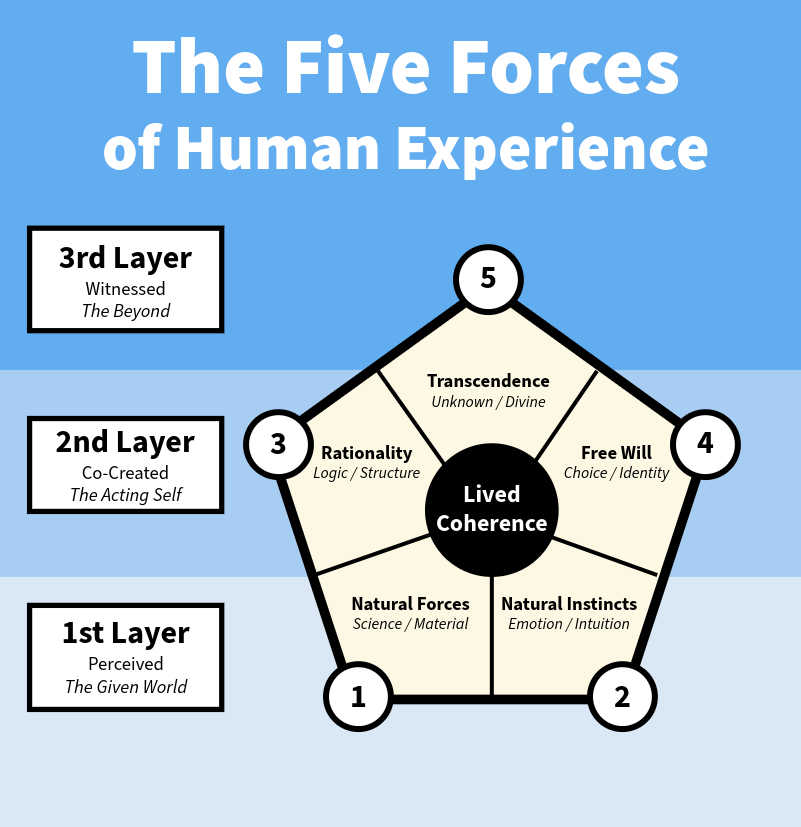
That question haunts me, because the modern intellectual climate increasingly wants to say: you’re a passenger. You just don’t know it.
Determinists say your choices are illusions produced by prior causes. Neuroscience studies show that the brain often begins preparing for action milliseconds before we consciously “decide.” Evolutionary biology frames much of behavior as adaptive responses to survival pressures, not deliberate moral choices. Materialism sees humans as extraordinarily complex machines, biological algorithms reacting to input with no room for true agency.
If these views are taken as absolute, free will appears to be a comforting myth. And if free will is a myth, then ideas like moral responsibility, growth, and transformation start to unravel.
But everyone, including the determinist, lives as though their choices matter.
The philosopher who publishes a book arguing that free will is an illusion still chose to write that book. Still chose her words carefully. Still hopes to persuade you, which only makes sense if you have the capacity to be persuaded and to change your mind. The scientist who argues that behavior is predetermined still holds his colleagues accountable for ethical lapses. Still praises good research and criticizes sloppy work. Still raises his children as though their choices will shape who they become.
The lived experience of agency is not an illusion we easily shrug off. It is embedded in the very fabric of how we live.
Free will is the force that makes ethics possible and drift inexcusable.
Think about what vanishes if choice is an illusion. Love matters because you are free to withhold it. Integrity matters because betrayal is an option. Compassion matters because indifference is easier. Justice matters because exploitation is tempting.
Without real choice, none of these carry moral weight. Goodness and evil become nothing more than chemical reactions. Courage, forgiveness, loyalty, sacrifice: these would be tricks of the brain, not acts of the soul.
Only when a person could choose otherwise does virtue mean anything. It’s easy to love when you are loved in return. It’s easy to be generous when you have more than enough. It’s easy to tell the truth when no consequences loom. But choosing love when resentment feels safer, choosing sacrifice when comfort beckons, choosing integrity when deceit would be rewarded: these choices shape who we are.
This is why our deepest stories center on choice and transformation. From ancient myths to modern literature, from religious parables to hero’s journeys, the pivotal moment is almost always the same. A choice must be made. Will you step into the unknown, even when you are afraid? Will you lay down your own desires for the sake of someone else? Will you stand for what is right, even when it costs you?
In The Lord of the Rings, it is not Frodo’s strength but his decision to carry the Ring that matters. In Harry Potter, it is not Harry’s magical abilities that define him but his choices to love, to protect, and to sacrifice. As Dumbledore tells him: “It is our choices, Harry, that show what we truly are, far more than our abilities.”
Free will doesn’t mean limitless choice or perfect autonomy. We are influenced by biology, culture, upbringing, and circumstance. Many decisions, especially fast, reflexive ones, happen below conscious awareness. I’m not arguing that every flicker of behavior is a deliberate act of will.
But larger, meaningful choices, the ones about forgiveness, sacrifice, and perseverance, often involve deliberate, conscious struggle. And evolutionary explanations, while they can describe why certain behaviors might be advantageous, cannot fully explain why a person would choose forgiveness over revenge when revenge would offer social power or emotional satisfaction. They cannot explain why someone would sacrifice their own life for a stranger or commit themselves to a cause they will never see completed.
Agency operates within limits, but it remains real.
You didn’t choose your genetics. You didn’t choose where you were born. But you can choose how you respond to injury, injustice, and opportunity. You can choose to forgive when bitterness seems natural. You can choose to persevere when giving up feels easier. You can choose to tell the truth when lying would protect you.
These choices are not always easy or obvious. But they are real. And they shape who you become.
Every act of choice presupposes a chooser. A self capable of reflection and direction. And this is where the conversation gets deeper than most people expect.
Beyond the ego (the constructed self, the collection of memories, desires, identities, and defenses we build as we navigate the world) there lies something older, quieter. What I call the soul. The part of us that hungers for meaning, truth, beauty, and goodness, not just for survival or pleasure. The part that recognizes that some things are worth suffering for. That grieves injustice not because it threatens us personally, but because it is wrong. That yearns for connection to something greater than the self.
Free will is the evidence of that deeper reality. It shows that you are not just a collection of atoms organized by accident. You are not merely the sum of your instincts or the product of your environment. You are a self. A being capable of real agency, real change, real love.
And if we were designed to choose, it raises a profound question: Who or what gave us that power?
The choices we most often celebrate, the ones we consider heroic, noble, and transformative, are not about survival at all. We honor those who choose sacrifice over self-preservation. We admire those who choose forgiveness over retaliation. We follow those who choose principle over popularity, truth over comfort. These choices are deeply human, and deeply disruptive to a purely survivalist narrative.
Free will points beyond instinct. Beyond survival. Beyond simple adaptation. It suggests that we are not just built to live. We are built to become.
Without choice, you are simply a passenger in your own story. With choice, you become a participant. An author, even, within the limits of your life’s pages.
Not perfectly. Not without stumbling. But freely. And that freedom, however bounded, is sacred.
Because choice, real, costly, courageous choice, is what transforms existence from mere survival into something that matters. It is the flame of personhood. The frontier where belief becomes action, hope becomes movement, and love becomes sacrifice.
Have you ever done something you knew you shouldn’t, and wondered, “Why did I do that?” Or surprised yourself by choosing the harder path because it felt right? Free will is a riddle at the core of being human.
You can doubt it at an intellectual level. You can construct clever arguments against it. But when you stand at a moral crossroads, when you feel the weight of a decision that will define who you are, you know in your bones that you are free.
Maybe not absolutely free. But truly free. Free enough to matter.
And that is the beginning of everything.