

There is a framework running in your head right now.
It is the structure you are using to decide what is real, what is true, what matters, and what you ought to do next. You did not necessarily choose it. Most of us inherited ours, from parents, schools, churches, social media, and the unspoken assumptions of the culture we grew up inside. Most people have never named the parts. But the framework is there, doing the work. It is shaping every interpretation, every reaction, every decision you make.
And if it is doing all that work, it is probably worth examining.
That is what the Library essays are for. They are not a self-help program. They are not a theology. They are a careful walk through the architecture of a worldview I have been building, line by line, over the past several years. The kind of framework you can hold up to the light, test against your own experience, take what is useful from, and adjust where you disagree.
This essay is the doorway into it. Two short series wait on the other side.
Why a Framework at All
A reasonable question to ask before going further: why does this need to be done at all? Why not just live, and trust that things will work out?
Because every life is already running on a framework, whether the person living it has named one or not.
If you trust that the world is intelligible, you are running on a framework. If you believe other people deserve dignity, you are running on a framework. If you think your choices matter, that some things are worth suffering for, that love is real, that justice is something more than a social agreement, every one of those convictions belongs to some structure of belief, even if you have never inspected it.
The question is never do I have a worldview? The question is do I know what mine is, and can it hold the weight I am placing on it?
The problem with unexamined worldviews is not that they are wrong. Many of them work fine for long stretches of life. The problem is what happens when life gets hard. When a marriage breaks. When a child suffers. When a diagnosis arrives. When the institutions you trusted disappoint you. In those moments, an unexamined worldview tends to crack along the lines it never tested. People who never noticed what they were running on suddenly find themselves in free fall.
A framework you have actually inspected is a framework that can carry weight. That is the practical case for slowing down and walking through this.
Two Layers
The framework has two layers, and the Library is organized around them.
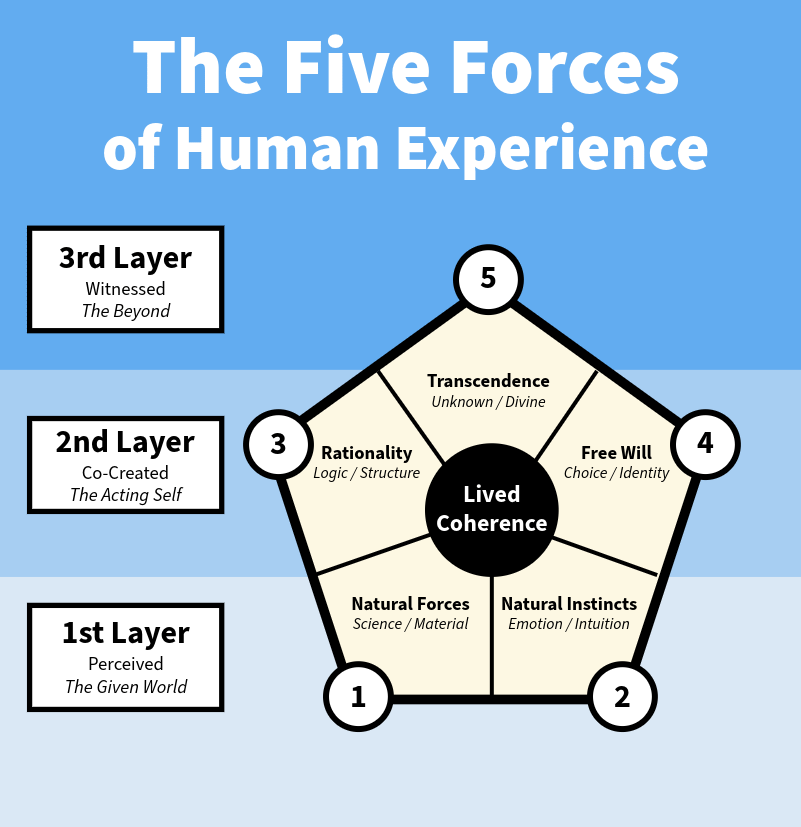
The first layer is about how we know. The Five Forces of Human Experience. Natural Forces (the measurable, testable, physical world). Natural Instincts (emotion, intuition, embodied knowing). Rationality (logic, argument, structured thought). Free Will (agency, choice, moral selfhood). Transcendence (the sacred, the mysterious, the part of reality that exceeds our instruments).
Everyone uses all five, every day, whether or not they would admit it. But every worldview weights them differently, elevating one or two, suppressing the rest. Scientism leans hard on Natural Forces and Rationality and quietly dismisses the others. Modern emotionalism leans on Natural Instincts and Free Will and treats reason and transcendence as suspect. Religious fundamentalism can lean on Transcendence to such a degree that it overrides everything else. Every belief system you can name is a particular weighting of these five lenses. Knowing which forces you have been leaning on, and which you have been suppressing, is the first move toward an honest worldview.
The second layer is about what is true. The First Principles of Reality. Three foundational truths that sit underneath everything else. Cause and Effect (the universe is structured; actions have consequences; the chain of causality reaches both backward beyond you and forward through you). Free Will (you are a genuine agent within that structure; your choices are real; you can be held responsible for them). Uncertainty (your knowledge of all of this is partial; you see through a lens; humility is not weakness but accuracy).
The first layer tells you about the instruments you use to see reality. The second layer tells you about what reality is. Together, they form a sturdy framework you can stand on.
What This Is Part Of
This is not a new project. Human beings have been doing it for as long as we have records.
Aristotle did it, methodically, two thousand three hundred years ago, walking through what kinds of things exist, what kinds of causes there are, what kinds of virtue make a life well-lived. Aquinas did it in the thirteenth century, integrating reason and revelation into a single architecture. Kant did it in the eighteenth century, asking what we can know and what we cannot. The American founders, in their own scrappier way, did it when they tried to build a political system on first principles about human nature. Every serious religious tradition has done it. So has every serious school of philosophy. So have cultures whose specific answers I would not accept, but whose seriousness about the question still deserves respect.
What I am offering is not original. It is a synthesis, in modern language, of what I have found most useful from this long tradition. The shape of the framework is mine. The pieces are not.
You may agree with most of it. You may disagree with most of it. You may find some pieces useful and others irrelevant. All of that is fine. What I am hoping for is not assent. It is examination. That you would notice what you are already running on, and ask whether it is what you actually want to be running on.
How to Read From Here
The Library is organized for exploration, not consumption. There is no required reading order, but here is the path I recommend.
Start with The Five Forces of the Human Experience (the next essay in this series). It introduces the lenses. Read it slowly. The forces will be the vocabulary every later essay uses.
From there, walk through the Five Forces essays one at a time. The Measurable World (Natural Forces). The Feeling Animal (Natural Instincts). The Reasoning Machine (Rationality). The Author (Free Will). The Mystery (Transcendence). Each one explores a single lens, what it sees clearly, and where it goes wrong when it tries to do the whole job alone.
Then move to the First Principles series, beginning with its introduction and then walking through the three foundational truths in order: Cause and Effect, Free Will, Uncertainty. The First Principles are heavier, more philosophical, and more load-bearing. They are also the place where the framework starts pointing beyond itself.
If you make it through all of that, the closing essay (Where I Stand) is my own personal landing point. It is the most personal of the Library essays, because it answers the question every framework eventually has to answer: and what do you actually believe, given all this?
Other readers will land somewhere different. That is the framework doing its job, not failing at it. The point was never agreement. The point was building something coherent enough to be honest about what you actually think.
So this is the doorway. The architecture is on the other side. Take your time. Disagree where you need to. And see if, when you have walked the whole structure, something more coherent emerges than what you walked in with.